
Reading the oldest light in the universe

Professor Battaglia is an observational cosmologist who uses the cosmic microwave background as a backlight to study how galaxies form, how the universe has evolved, and whether new physics lies beyond the Standard Model. As this ancient light travels to Earth, it picks up subtle imprints from the matter it passes through, including the thermal and kinetic Sunyaev-Zel'dovich effects; by decoding these signals with large-scale surveys and simulations, his group maps otherwise-invisible reservoirs of ordinary matter, studies the feedback processes that shape galaxies, and tests gravity on the largest scales ever probed.

He is directly involved in the Atacama Cosmology Telescope, the Simons Observatory, and the CCAT Observatory's Fred Young Submillimeter Telescope (FYST), Cornell's flagship submillimeter telescope now approaching its first science observations.

  • Cornell University
  • CCAT Observatory / FYST
  • Simons Observatory

CMB secondary anisotropies

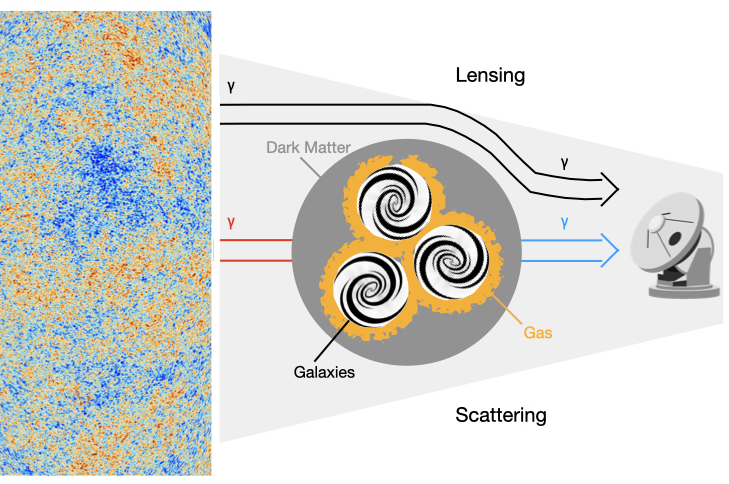
As CMB photons travel to us, they are lensed by intervening dark matter and scattered by the hot gas in and around galaxies and clusters. These secondary anisotropies — gravitational lensing, and the thermal and kinetic Sunyaev-Zel'dovich effects — let us map the distribution of matter and gas across cosmic time, independent of how much light galaxies emit.
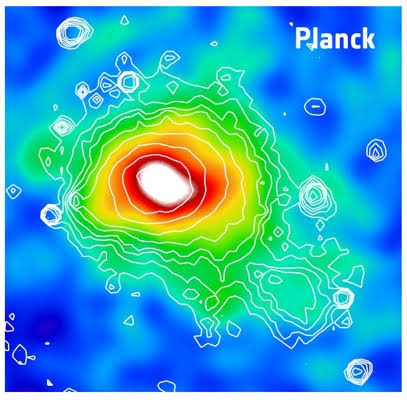
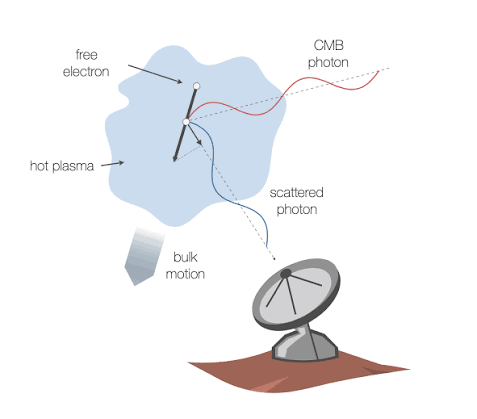
Planck Sunyaev-Zel'dovich map of the Coma cluster Schematic of the Sunyaev-Zel'dovich effect

Cosmology with Galaxy Clusters

Galaxy clusters are the largest gravitationally bound structures in the universe, and their abundance and growth over time are a sensitive probe of cosmology. My group combines SZ and lensing observations with hydrodynamic simulations to understand cluster astrophysics well enough to use clusters as precision cosmological probes.

The Epoch of Reionization

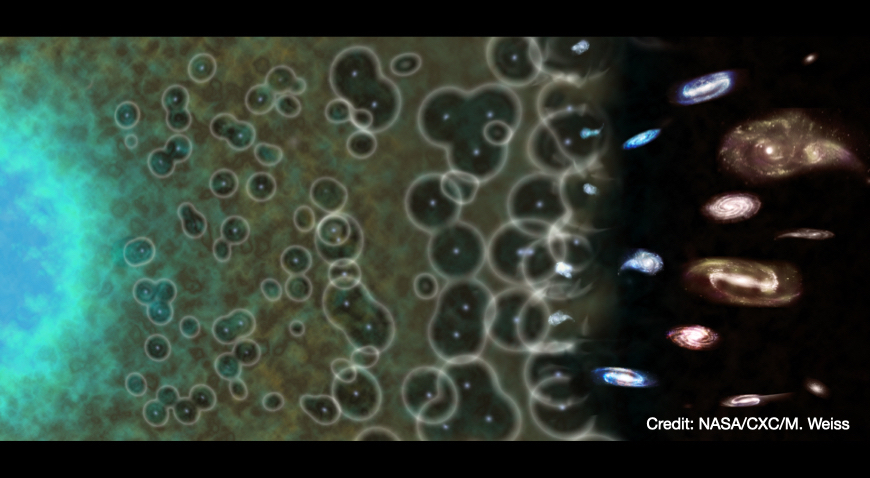
The first stars and galaxies reionized the hydrogen filling the universe, leaving imprints on the CMB and the 21cm signal from neutral hydrogen. We use large-volume simulations to model this process and connect upcoming radio and CMB observations to the properties of the earliest galaxies.